For several months, District 7 has been refocusing and strengthening our long-standing 1:1 technology initiative to ensure we promote safe, purposeful, and balanced use of technology and AI. We are listening to input from our teachers and families as we develop new guidelines and select tools and resources that best serve students academically and support their overall wellbeing.
Importantly, we recognize our decisions must be driven by data and best practices. At the end of the 2025-2026 school year, nearly 400 D7 teachers provided feedback about how technology is used in our classrooms, how it impacts our students, and what they believe is needed for the future. All of this has led us to begin this school year with a new set of guidelines and initiatives designed to better support teachers and students.
We view this as a shared responsibility between school and home, and we are committed to partnering with families to help our students use technology in ways that support their learning, wellbeing, and long-term success.
Refocusing our Purpose
As technology tools and artificial intelligence (AI) rapidly expand, it is more critical than ever to equip our students for college, careers, and everyday life by helping them learn to use technology safely, responsibly, and effectively while maintaining strong academic integrity and critical thinking skills.
Feedback from teachers and families provided a clear pathway towards accomplishing this:
Stronger and clearer district expectations,
classroom monitoring tools for student devices,
stronger guidelines for technology use, and
increased communication with families about these guidelines and about healthy digital habits.
Listening to that feedback, we are pleased to implement the following for the 2026-2027 school year:
Apple Classroom
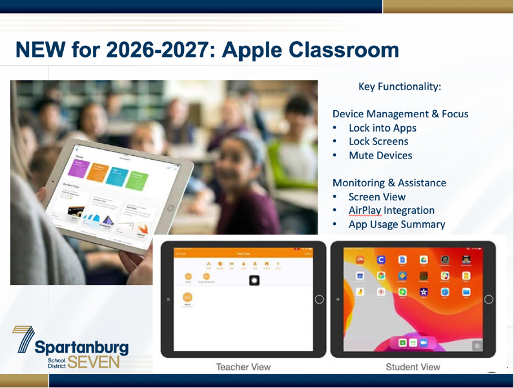
One of the most highly requested tools in our survey was Apple Classroom, a classroom management application that helps teachers guide and support use of student devices during instructional time. This summer, all student devices were enabled for its use.
Teachers can monitor student device activity during class to ensure technology is being used appropriately and for instructional purposes. Teachers can view screens remotely, lock a device to a specific screen or app (such as during test taking), or restrict access when a student is not following classroom directions. At the end class, teachers can review a summary of how student devices were used, including time spent on specific websites and applications.
As always, student devices are governed by our district’s technology use policy and inappropriate use may result in disciplinary consequences. Our goal is to create a learning environment where technology enhances instruction, supports student success, and is used responsibly.
Students will be hearing about Apple Classroom at school and we ask families to have conversations at home to make sure they are aware of its capabilities and understand the importance of using devices appropriately for their benefit and wellbeing.
D7’s Digital Ready Curriculum
Students will participate in our Digital Ready initiative, a curriculum designed by our instructional technology team to help students become safe, respectful, responsible, and confident participants in digital spaces. Digital citizenship is an essential life skill, and we are committed to preparing students to navigate an increasingly connected world with wisdom and integrity.
As part of this effort:
Students will be introduced to monthly Digital Ready topics through schoolwide communication.
Teachers will facilitate age-appropriate discussions and activities focused on topics such as online safety, responsible technology use, and ethical decision-making.
Lessons have been designed to align with state standards and support students in developing the skills needed to thrive in today's digital world.
We welcome parents to follow along with our Digital Ready lessons for elementary schools, our lessons for middle schools, and our lessons for high school, which are aligned to state standards.
Artificial Intelligence (AI) Guidelines
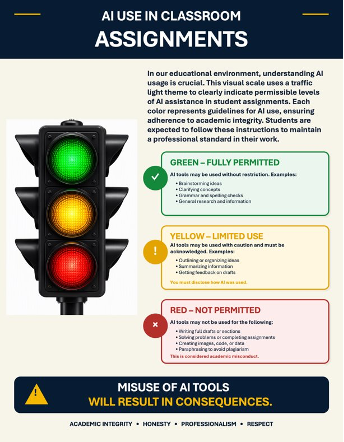
Preparing students for a future where AI is increasingly common in college, careers, and everyday life means teaching them how to use these tools with academic integrity and personal responsibility. Our new AI “traffic light” classroom guide provides a consistent approach for teachers to communicate when and how AI may be used in assignments. It complements our new board policy on AI responsible use and our new AI position statement.
Teachers will clearly identify and discuss the AI designation (Green, Yellow, or Red) for major assignments and assessments before students begin their work.
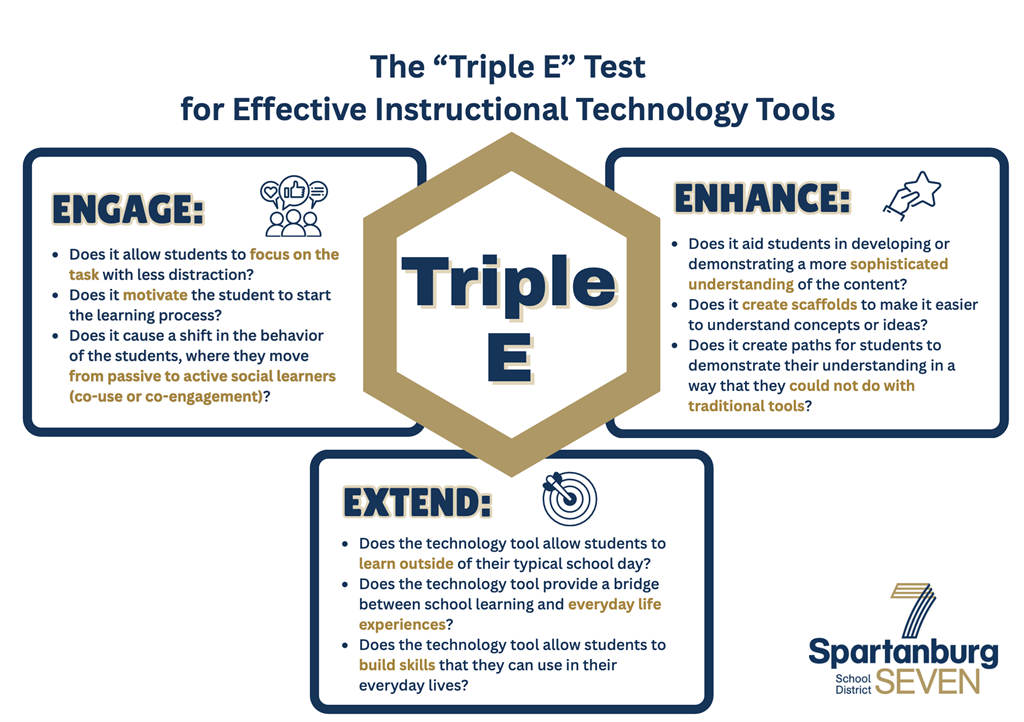
Triple “E” Guide for Effective Instructional Technology
We expect technology to have a clear instructional purpose that supports student learning. Teachers will use our new Triple E Guide to help evaluate technology use in their classrooms to ensure it enhances, extends, and/or engages student learning in ways that support the intended learning outcomes.
i-Ready: A Refocus on Appropriate Use
As part of our commitment to intentional and purposeful technology use, we are placing a renewed emphasis on the appropriate use of i-Ready.
i-Ready is a valuable resource that aligns with SC Ready and provides personalized practice and support in reading and mathematics. It is designed to supplement classroom instruction, not serve as a substitute for the rich, engaging learning experiences students receive from their teachers.
To ensure that students receive the greatest benefit from the program, District 7 is refocusing on appropriate use guidelines and monitoring usage data to ensure alignment. Students should not regularly exceed:

Additional Technology Initiatives
Revised Approach to Digital Device Usage in Elementary Schools
Beginning this school year, elementary student devices will remain at school. This adjustment reflects our commitment to ensuring that technology is used purposefully during the school day while encouraging students to engage in a healthy balance of activities outside of school. Keeping devices at school also allows us to better manage device use, support students' developmental needs, and ensure technology remains a tool for learning rather than a constant presence in students' daily lives.
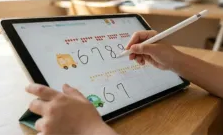
Digital Pencils and iPads for Second Grade Students
To better support the development of proper handwriting, pencil grip, and fine motor skills, D7 is providing digital pencils for all second grade students to use with classroom iPads. Last year, we converted all second grade classrooms from laptops to iPads, which provide several benefits for younger learners including the ability to manually manipulate mathematical images. While technology provides valuable opportunities for learning, we also recognize the importance of foundational developmental skills.
Implementation and Expectations
Our goal is to ensure District 7 remains on the forefront of best practices and delivers excellence to students and families. Our instructional technology team is working with teachers and staff to fully implement these guidelines and tools.
Working together, these new initiatives will help:
Increase student focus and productivity during technology use by giving teachers better capability to monitor and manage student device use (Apple Classroom)
Guide teachers in evaluating effective technology use in their classrooms (Triple E guide)
Create a consistent approach for communicating expectations about when and how AI may be used in assignments (AI classroom guide)
Ensure students are prepared to navigate the digital world with wisdom and integrity (Digital Ready curriculum guide)
Realign district-wide i-Ready use to effective, research-based guidelines that maximize student academic growth (i-Ready Refocus)
Support foundational developmental skills in elementary students and help them establish a healthy balance in their technology use (Digital Pencils and iPads, Devices Stay at School)
District 7 thanks our parents and guardians for their continued partnership as we prepare District 7 students to thrive in an increasingly digital world while maintaining a strong focus on the relationships, experiences, and instructional practices that matter most.
Mission Accepted!